
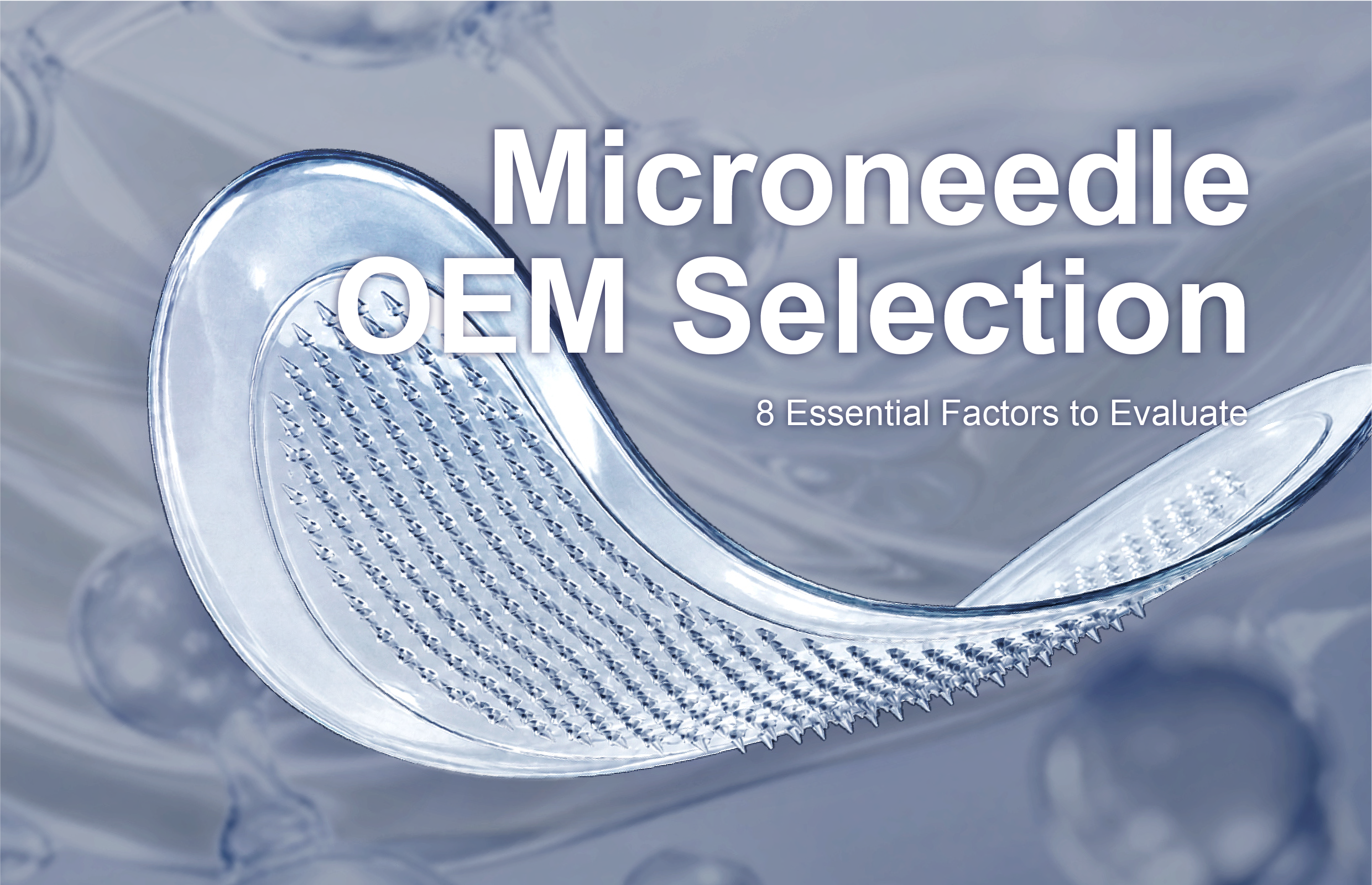
8 Essential Factors Every Beauty Brand Should Evaluate Before Launching
Launching a microneedle skincare product is no longer reserved for multinational beauty companies. Today, independent skincare brands, medical aesthetic clinics, and global cosmetics companies are increasingly adopting dissolving microneedle technology to create premium, high-performance products.
However, the success of your product depends on more than the formula itself.
Choosing the right microneedle OEM manufacturer will directly affect product quality, regulatory compliance, production scalability, and ultimately your brand’s reputation.
So how do you evaluate a manufacturing partner?
Here are eight key factors every beauty brand should consider.
1. Does the Manufacturer Specialize in Dissolving Microneedles?
Not every cosmetic factory has the capability to manufacture dissolving microneedles.
Unlike traditional sheet masks or serums, dissolving microneedles require precise control over:
- Microneedle geometry
- Mold accuracy
- Needle strength
- Ingredient loading
- Dissolution consistency
Manufacturers without dedicated microneedle expertise often outsource critical production processes, making quality control more difficult.
A specialized manufacturer should have proven experience developing dissolving microneedle products rather than treating them as an extension of conventional skincare manufacturing.
2. How Strong Is Their Precision Manufacturing Capability?
Microneedle production is essentially precision manufacturing.
Every microneedle must be produced with consistent dimensions to ensure predictable skin penetration and ingredient delivery.
Manufacturers with backgrounds in precision engineering often have stronger capabilities in:
- Mold fabrication
- Automated production
- Process consistency
- Quality inspection
- High-volume manufacturing
At MicroDoctor, dissolving microneedles are developed on the precision manufacturing foundation established by Darwin Precisions Corporation, bringing decades of engineering expertise into skincare production.
3. Do They Offer Complete OEM / ODM Services?
Developing a skincare product involves far more than manufacturing.
A reliable partner should provide comprehensive services including:
- Formula development
- Microneedle engineering
- Packaging consultation
- Regulatory documentation
- Pilot production
- Mass manufacturing
- Private labeling
Working with a one-stop OEM partner simplifies communication and shortens development timelines.
4. Are They Certified for International Markets?
Global beauty brands need manufacturers that comply with international quality standards.
Important certifications include:
- ISO 22716 (Cosmetic GMP)
- FDA Registration
- HALAL Certification
- QMS Quality Management System
These certifications demonstrate that manufacturing processes follow internationally recognized quality standards, helping brands prepare for overseas markets.
5. Can They Support Product Innovation?
Every skincare brand wants something unique.
Ask whether the manufacturer can customize:
- Microneedle shapes
- Patch designs
- Active ingredients
- Dissolution time
- Patch size
- Packaging
A manufacturer capable of customization allows brands to differentiate instead of competing with identical stock products.
6. Do They Have Clinical Testing Capabilities?
Modern consumers increasingly expect products supported by scientific evidence.
Manufacturers that can assist with clinical testing provide additional value by helping brands validate product performance.
Examples include:
- Skin hydration
- Wrinkle appearance
- Brightening performance
- Skin elasticity
- Consumer usability studies
Some manufacturers also support IRB-approved human studies to generate stronger product claims for marketing materials.
7. Can They Scale Production as Your Brand Grows?
Many startups begin with relatively small production volumes.
As sales increase, production demand can expand significantly.
An experienced OEM partner should be capable of supporting:
- Pilot production
- Medium-volume manufacturing
- Global distribution
- Stable quality across production batches
Scalable manufacturing reduces the need to switch suppliers during business growth.
8. Do They Have a Long-Term Innovation Roadmap?
Technology evolves quickly.
A manufacturing partner should continue investing in:
- New microneedle materials
- Improved delivery systems
- Better ingredient compatibility
- Sustainable manufacturing
- Patent development
Long-term R&D capability helps ensure your products remain competitive as market expectations continue to evolve.
Questions to Ask Before Choosing a Microneedle OEM
Before signing an OEM agreement, consider asking:
- How many microneedle products have you commercialized?
- Do you manufacture in-house?
- What quality certifications do you hold?
- Can you customize formulations and patch designs?
- Do you provide regulatory documentation?
- Can you support clinical testing?
- What is your production capacity?
- How do you ensure batch-to-batch consistency?
These questions can reveal whether a manufacturer is truly equipped to support your business over the long term.
The Right Manufacturer Becomes Your Long-Term Innovation Partner
Choosing a microneedle OEM manufacturer isn’t simply about finding the lowest production cost.
The right partner contributes expertise in engineering, formulation, manufacturing, regulatory compliance, and product innovation, helping brands bring high-quality microneedle products to market with greater confidence.
As dissolving microneedle technology continues to reshape the skincare industry, selecting a manufacturer with proven technical capability, international certifications, and scalable production infrastructure can become one of the most important strategic decisions your brand makes.